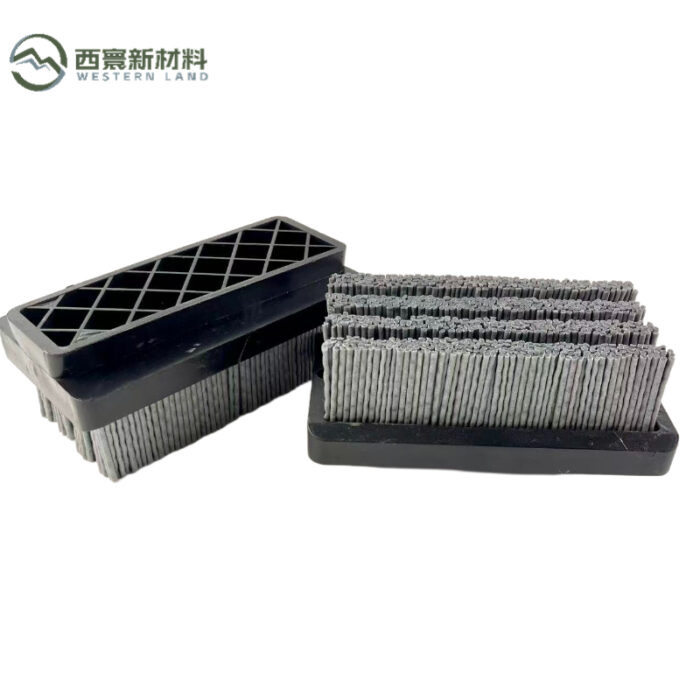
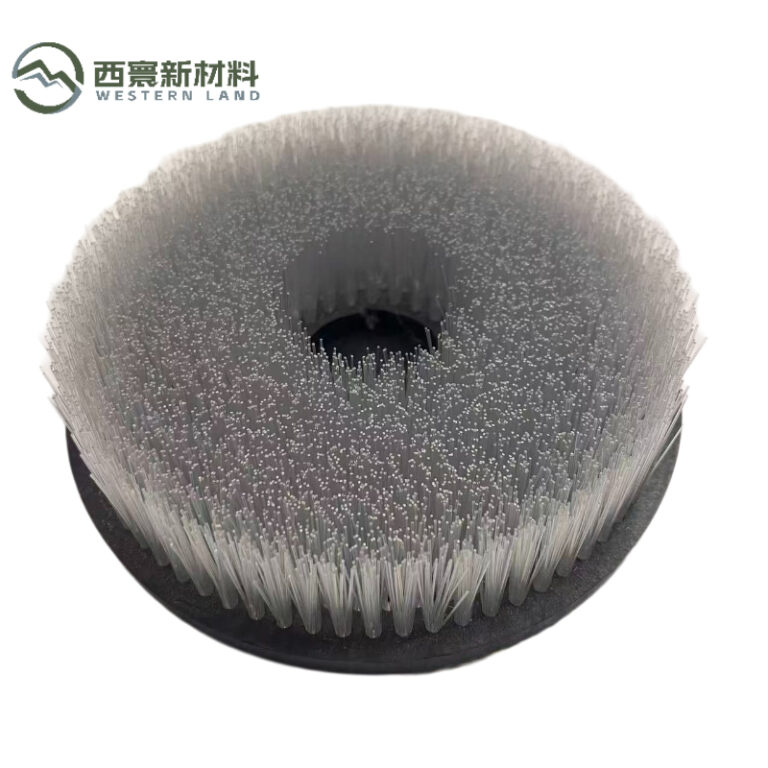
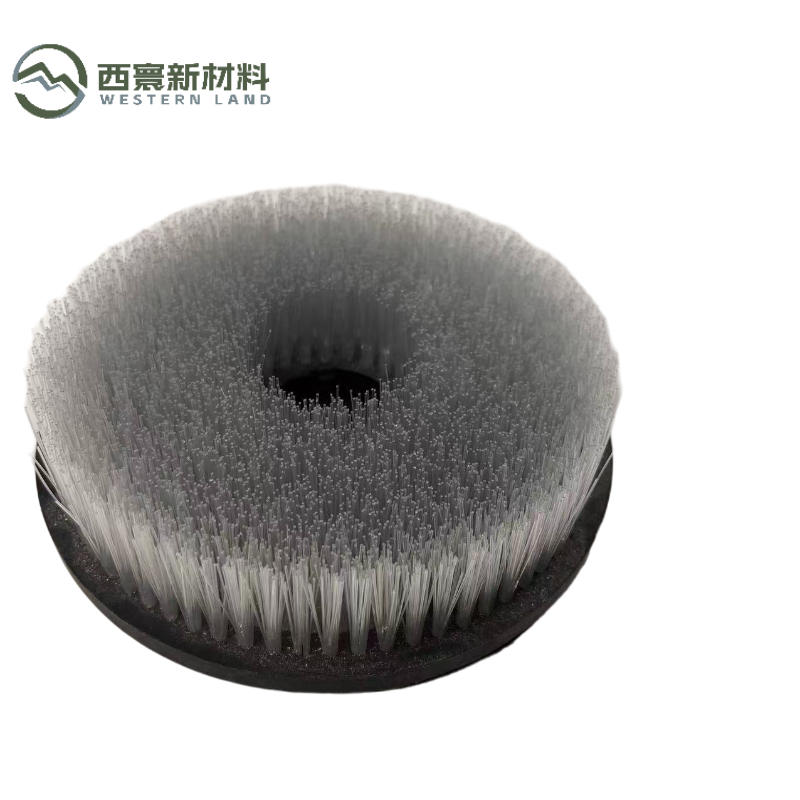
D160 Disc Antique Abrasive Brush — Clean Excess Wax & Antique Travertine in One Pass
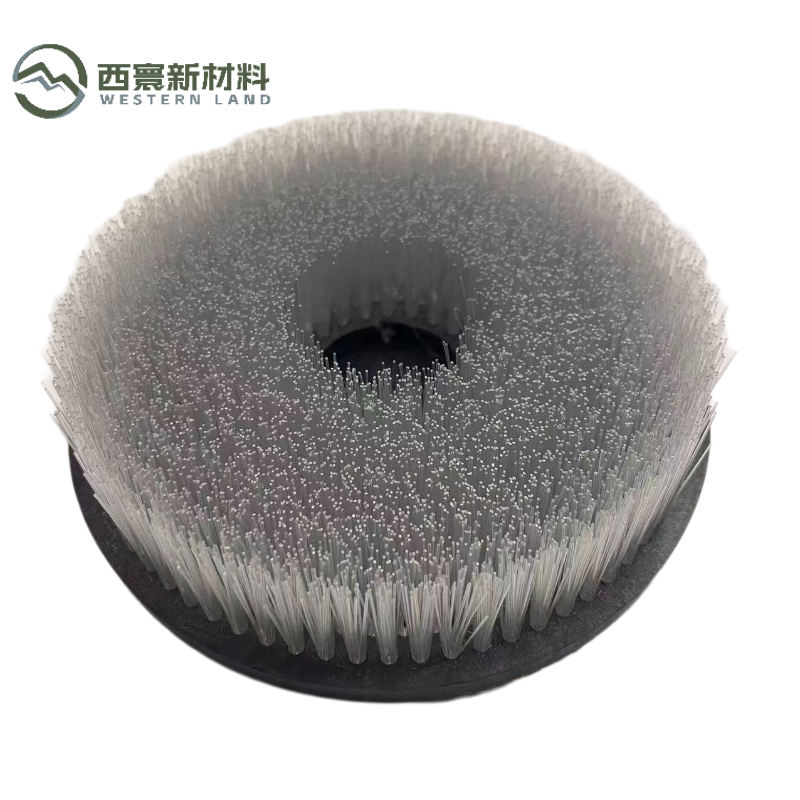
Industrial-grade D160 disc antique abrasive brush with premium stiff nylon abrasive filament for nano-coating wax machines. Strips excess wax from matte & luster tiles, antiques travertine and relief-glaze surfaces, and runs wet without clogging. Multiple sizes available for OEM/ODM.
Product Overview
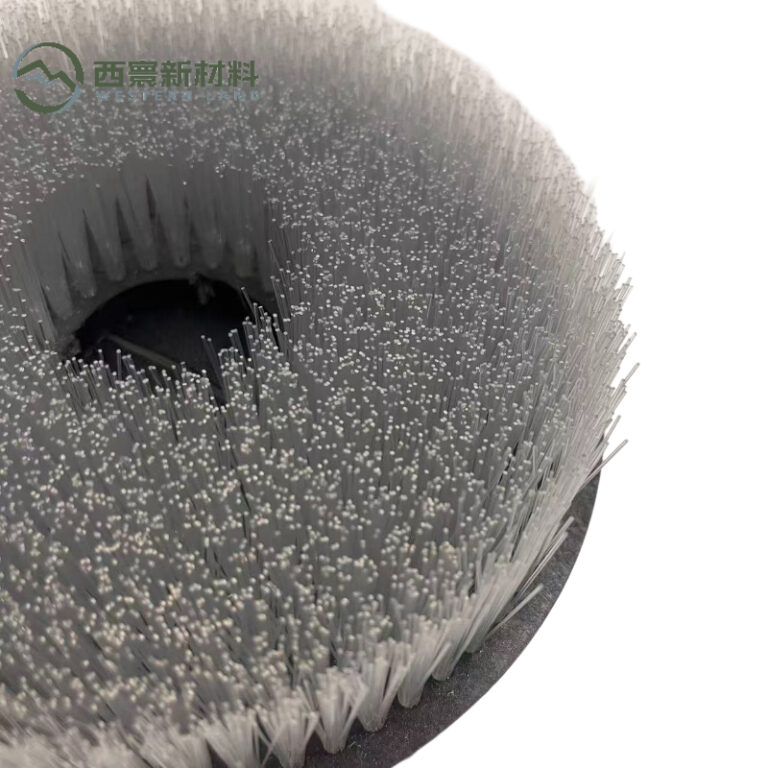
The D160 disc antique abrasive brush from Western Land Tools is built specifically for the nano-coating / tile waxing machine — the step where freshly waxed tiles have excess wax that must be buffed off cleanly, and where travertine / relief-glaze surfaces need a uniform antiqued finish.Standard nylon or fiber brushes either shed filaments into the wax bath, glaze over too fast, or burnish the surface instead of antiquing it. The D160 solves all of that with a premium stiff nylon abrasive filament that’s anti-fallout, a moderate-hardness grit formulation tuned for matte and luster porcelain, a thick stable base plate for high-RPM nano-coating machines, and a wet-friendly filament structure that stays sharp in a wax-and-water slurry.Result: a uniform, swirls-free antiqued finish on every tile, every batch — designed for B2B wax / nano-coating lines and travertine antiquing shops running multiple shifts.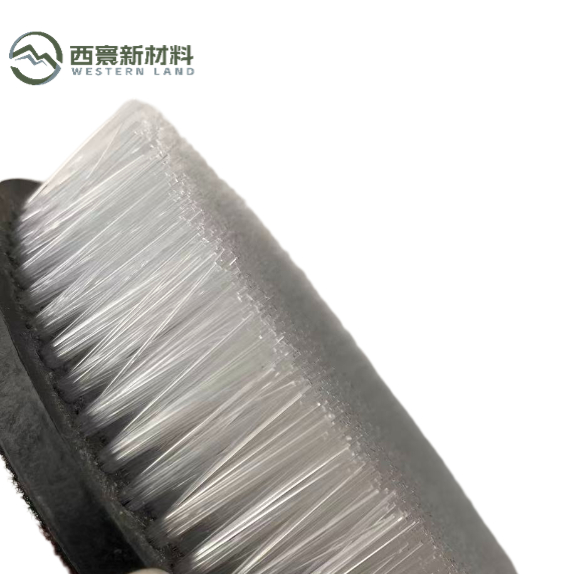
6 Customer Pain Points We Solved
Premium Stiff Nylon Abrasive Filament
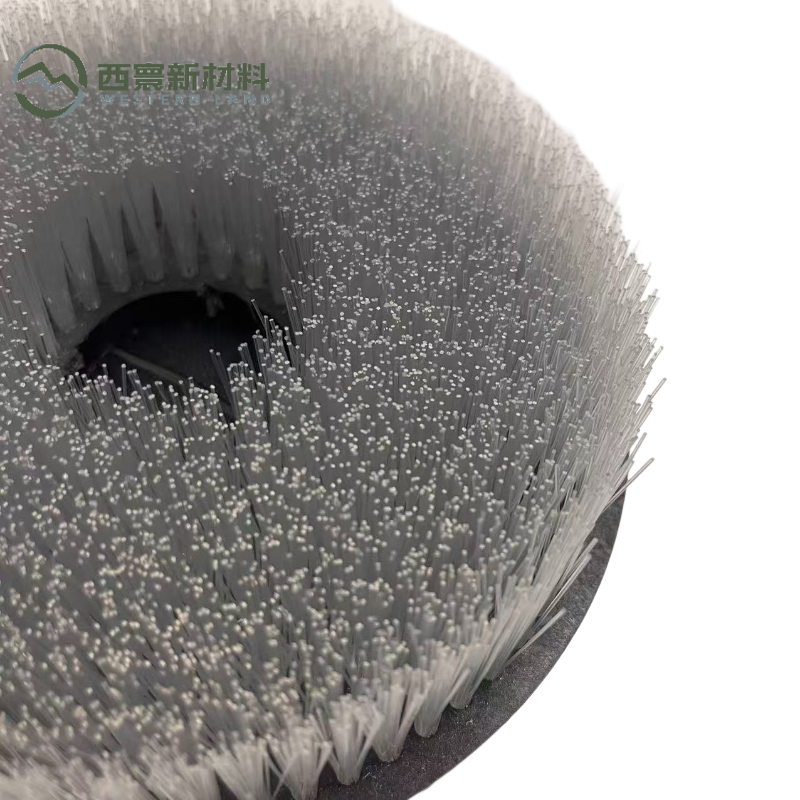
Most “antique brushes” on the market shed filaments into the wax slurry within the first hour — contaminating the nano-coating tank and leaving nylon debris on the finished tile. Our premium stiff nylon abrasive filament is engineered to be anti-fallout and resistant to shedding, so the brush keeps its shape and your wax tank stays clean.Moderate Hardness — Gentle on Matte & Luster Tiles
A brush that’s too hard will scratch matte tiles or burnish luster tiles back to a polished gloss — destroying the very finish the waxing step is supposed to set. The D160 uses a moderate-hardness abrasive formulation tuned for nano-coating processes. It removes excess wax without scratching the matte surface or changing the luster grade.Thick Stable Base for High-Speed Operation
Nano-coating machines run at high RPM — an unstable base plate makes the brush wobble at speed, leave swirl marks, and wear unevenly. The D160 has a thick, balanced, CNC-machined base plate that holds its balance at full machine RPM. Result: no swirls, even wear across the disc, full coverage of every tile.Wet-Use Friendly, No Clogging
Wax + water is the perfect environment for a brush to glaze over, clog, or load up with residue. The D160’s filament geometry is open enough to shed slurry and keep the abrasive cutting all shift. No stoppages for cleaning the brush in the middle of a batch.Consistent Grit for Uniform Antiquing
Inconsistent grit depth = inconsistent antiquing — light spots, dark spots, “tiger stripes” on the tile face. The D160 filament is precision-impregnated with a uniform abrasive profile, so every square inch of the disc does the same job. Uniform antique finish on every tile, every batch.OEM / ODM With Multiple Sizes
Western Land manufactures the D160 in multiple diameters for different nano-coating machines and tile sizes, plus OEM / ODM service for custom filament hardness, grit grade, color, and base plate hole pattern. Contact us for special specs and packaging.Key Features
- Premium Stiff Nylon Abrasive FilamentAnti-fallout, no easy shedding — clean wax tank, clean tile face.
- Moderate-Hardness FormulationTuned for matte & luster tile — removes excess wax without scratching or burnishing.
- Thick Stable Base PlateCNC-balanced for high-RPM nano-coating machines — no wobble, no swirls, even wear.
- Wet-Use Filament GeometryOpen structure sheds wax slurry — no glazing, no stoppages, all-shift performance.
- Uniform Grit ProfilePrecision-impregnated abrasive — uniform antique finish, no tiger stripes.
- Multiple Sizes + OEM / ODMStandard D100–D160 series plus custom filament, grit, color, and base hole patterns.
Specifications
| Product Name | D160 Disc Antique Abrasive Brush (D160 圆盘仿古研磨刷) |
|---|---|
| Model | D160 (customizable to other diameters) |
| Brush Type | Disc-style abrasive brush for nano-coating / tile waxing machine |
| Filament Material | Premium stiff nylon abrasive filament (anti-fallout) |
| Filament Hardness | Moderate (tuned for matte & luster tile — not too soft, not too aggressive) |
| Abrasive | Silicon carbide / aluminum oxide grit, uniform impregnation |
| Base Plate | Thick, CNC-balanced base plate (anti-wobble at high RPM) |
| Use Mode | Wet use (water + wax slurry) |
| Compatible Machine | Nano-coating machine / tile waxing machine / disc-buffing line |
| Typical Application | Excess wax removal on porcelain tile, travertine antiquing, relief-glaze finishing |
| Available Sizes | D100 / D120 / D140 / D150 / D160 (custom diameters on request) |
| Service | OEM / ODM — custom filament hardness, grit grade, color, hole pattern |
Available Sizes (from spec sheet)
| Model | Diameter (mm) | Filament Length (mm) | Base Plate Thickness (mm) |
|---|---|---|---|
| D100 | 100 | 30 / 40 / 50 | 15 |
| D120 | 120 | 30 / 40 / 50 | 15 |
| D140 | 140 | 30 / 40 / 50 | 18 |
| D150 | 150 | 30 / 40 / 50 | 18 |
| D160 (Featured) | 160 | 30 / 40 / 50 | 20 |
Reading the table: Diameter is the outside brush diameter in millimeters. Filament length is the working bristle length (choose 30 / 40 / 50 mm depending on how aggressive you want the antiquing action). Base plate thickness is the steel / aluminum plate under the filament (thicker plates handle higher RPM with less wobble). The D160 size is featured as the most common size for nano-coating machines working on 600–800 mm tile.
What Is a “Disc Antique Abrasive Brush”?
A disc antique abrasive brush is a flat circular brush used on nano-coating machines, tile waxing machines, and disc-buffing lines. Unlike a flap wheel or a cylindrical brush, the disc shape gives:- Full-face contact across a tile, so the antiquing action is uniform (no stripe marks).
- Even wear along the radius — the disc wears evenly instead of loading up on one edge.
- Easy balance at high RPM — the disc geometry is naturally stable on a spindle.
How the Anti-Fallout Filament Works
“Anti-fallout” isn’t marketing language — it’s a specific filament construction. Here’s what it means on the D160:- The nylon filament is anchored into the base plate with a high-temp resin bond rated for wax-and-water service.
- The filament diameter is sized to resist bending fatigue — it flexes under load but doesn’t break off.
- The abrasive grit is impregnated into the nylon, not glued on top — so it can’t flake off into the wax.

Choosing the Right Diameter & Filament Length
Match the D160 to your machine and tile size:- D100 (100 mm) — small disc-buffing stations, narrow tiles, edge work. The most popular size for handheld detail work.
- D120 / D140 (120–140 mm) — mid-size nano-coating machines, 400–600 mm tile.
- D150 / D160 (150–160 mm) — full-size nano-coating / waxing lines, 600–800 mm and larger tile. The featured size for high-volume B2B lines.
- 30 mm filament — light wax removal, fine matte finish, less aggressive.
- 40 mm filament — standard antiquing on matte / luster porcelain.
- 50 mm filament — deeper antique on travertine, relief-glaze, rough finishes.
Not sure which combination fits your line? Send us your nano-coating machine model, tile size, and target finish. We’ll spec the diameter + filament length + grit grade.
Contact us for sizing help →
How to Get the Best Antique Finish
- Always run wet. The D160 is designed for wax + water. Dry running destroys the filament and burns the tile face.
- Match filament length to finish depth. Use 30 mm for fine matte, 40 mm for standard antique, 50 mm for deep travertine / relief-glaze antiquing.
- Keep a steady feed rate. Too slow = glazing. Too fast = swirls. Match the line speed your nano-coating machine is set up for.
- Rinse the brush at shift end. A quick rinse in clean water keeps the filament open and extends service life.
- Replace as a set. If one disc wears out, replace the row as a set to keep the antique finish uniform across the line.
Recommended Applications
- Excess wax removal on porcelain tile after the waxing bath
- Nano-coating lines for matte and luster finished tiles
- Travertine antiquing for fill-and-hone travertine finishes
- Relief-glaze finishing on glazed ceramic with embossed patterns
- Stone waxing lines for limestone, sandstone, light marble antiquing
- Tile factories running 5,000–50,000+ m² of antique-finish tile per month
- B2B waxing & antiquing service providers serving multiple tile brands
- OEM private-label for nano-coating machine manufacturers and tile line builders
Pair With Other Western Land Tools
The D160 disc antique brush completes the final wax / antiquing step on a nano-coating line. For the earlier grinding & polishing steps on the same tile, Western Land Tools offers:Contact us for full line specs Silicon Carbide Nylon Abrasive Brush Fiber Abrasive Block L140 Rubber Abrasive Brush L140For background on how nano-coating works on tile surfaces, see this external reference on nanocoating as a thin-film surface treatment.Frequently Asked Questions
What is a D160 disc antique abrasive brush used for?
A D160 disc antique abrasive brush is a flat circular nylon abrasive brush mounted on a nano-coating or tile waxing machine. It removes excess wax from porcelain tile and produces a uniform antique finish on travertine, relief-glaze, and other textured stone surfaces. The 160 mm diameter is the most popular size for B2B nano-coating lines.Why does the filament need to be “anti-fallout”?
On a nano-coating line, the brush sits in a wax + water slurry. A standard nylon filament will start shedding into the tank within hours — contaminating the wax bath and leaving nylon fibers on the tile face. The D160’s premium stiff nylon filament with anti-fallout bond stays in place under full production use, keeping both the brush and the wax tank clean.Can the D160 burnish a matte tile back to gloss?
No — the moderate-hardness filament formulation is tuned for matte and luster tile specifically. It removes the excess wax without scratching the matte face or burnishing the luster face. If you need a stronger antiquing action for travertine, go to a longer filament (50 mm) or a harder grade — contact us to discuss the spec.Is the D160 wet or dry?
Wet only. The D160 is designed for the wax + water environment of a nano-coating line. Dry running this brush destroys the filament bond and may burn the tile face. Make sure your machine has a working water feed and a wax slurry bath.Which diameter should I pick for my nano-coating machine?
The diameter depends on your machine’s spindle size and the tile width on your line: D100 for narrow tile and detail work, D120 / D140 for mid-size machines, D150 / D160 for full-size production lines on 600–800 mm+ tile. Send us your machine model and we’ll confirm the right diameter. Contact us for sizing help.What filament length should I pick — 30, 40, or 50 mm?
The filament length controls how aggressive the antiquing action is: 30 mm = light wax removal, fine matte finish; 40 mm = standard antiquing on matte / luster porcelain; 50 mm = deeper antique on travertine, relief-glaze, rough finishes. If you run multiple tile types, order the full set and swap by application.How long does the D160 last in production?
Service life depends on the tile hardness, wax chemistry, water flow, and feed speed. As a rough guide, a D160 disc running full production on matte porcelain lasts 30–90 days before replacement. Rinsing at every shift end and matching the filament length to the tile type extends life significantly.Can I get custom sizes or OEM private-label packaging?
Yes. Custom diameters (e.g. D170 / D180 / D200), custom filament hardness, grit grade, color, and base-plate hole patterns are all available. Full OEM / ODM service with private-label packaging and bonded warehouse programs is supported for nano-coating machine builders and high-volume buyers.Where can I learn more about the nano-coating process?
For background on how nano-coating works as a thin-film surface treatment, see this external reference on nanocoating. For a general overview of travertine and how it’s typically antiqued, see travertine.Need a quote, custom filament spec, or full-line OEM packaging?
Send us your nano-coating machine model, tile type, and target finish — we’ll respond within 24 hours. Contact Western Land Tools →